How to Reduce Tenant Turnover & Vacancy in the Bay Area (2026)

October 4, 2026

By: Jian Hui Zhu, Real Estate Broker (DRE #02129313)

Published by ETRO Group Inc. (DRE #02441215)

Share this article

In the San Francisco Bay Area, tenant turnover is far more than an operational inconvenience — it is a severe, compounding financial drain.


Between the direct loss of rental income during the vacancy gap, deep professional cleanings, repairs, staging, marketing, and potential leasing commissions, a single turnover event can easily cost anywhere from $3,000 to over $7,000 depending on the submarket.


With regional rental demand stabilizing across San Francisco, Silicon Valley, the Peninsula, and the East Bay — bolstered by a tight vacancy rate hovering between 2.5% and 4.5% and year-over-year rent growth averaging 3% to 5% — smart owners are shifting their focus away from chasing aggressive rent hikes. The smartest money in the Bay Area is being deployed into tenant retention, asset optimization, and long-term yield preservation.


Part 1: Anatomy of the Modern Bay Area Renter (2026 Profile)

To keep your units occupied, you must first understand the evolving professional profile of today's Bay Area renter. The post-pandemic economy and the rapid maturation of the AI sector have fundamentally transformed tenant expectations.


1. The Hybrid Tech & AI Workforce Economy

The massive influx of capital and talent into the artificial intelligence sector — anchored by headquarters, research labs, and major expansions across San Francisco, San Jose, Palo Alto, and Mountain View — has injected a wave of well-compensated professionals into the local rental market. Many are locked into strict 3-to-4-day hybrid in-office schedules, so they treat a dedicated home-office space, high-speed fiber internet, and smart layouts as non-negotiable. Properties lacking efficient remote-work configurations face prolonged vacancies; functional ones command immediate, loyal occupancy.


2. The Persistent Homeownership Gap

With median single-family prices routinely eclipsing $1.5M to $2M+, a large demographic of high earners has accepted long-term renting as a permanent lifestyle choice rather than a stepping stone to ownership. These aren't transient students — they are established professionals and families seeking an elevated living experience and stable management, often for 3 to 5 years or longer.


Part 2: Proactive Maintenance — Your #1 Retention Engine

Ask any seasoned Bay Area operator what triggers a non-renewal, and the answer is rarely the rent amount — it's deferred maintenance. When a tenant feels ignored, psychological detachment sets in and they start browsing listings.

  • Deploy frictionless digital maintenance portals. Software like AppFolio, Buildium, or TenantCloud logs requests instantly, tracks them transparently, and routes them to vetted vendors without administrative lag.
  • Build a reliable local contractor network. Establish recurring agreements with trusted plumbers, electricians, and technicians across your submarket so critical tickets are resolved within 24 hours.
  • Run rigorous preventative upkeep. Seasonal checklists — annual HVAC servicing, water-heater flushes, gutter and roof clearing before the rainy season — protect both the asset and the tenant's peace of mind.


Part 3: Navigating California & Local Rent Regulations

Operating in the Bay Area requires uncompromising compliance. A single procedural misstep can trigger penalties, disputes, or accidental lease violations that disrupt cash flow.

  • Master AB 1482 limits. Annual increases on covered units are capped at 5% plus local CPI, or a hard ceiling of 10%, whichever is lower. State caps shift annually on August 1st based on regional CPI figures, bringing the post-August regional cap to 8.8% across the Bay Area. Always verify the exact effective month of your notice.
  • Respect strict local ordinances. Municipalities like San Francisco, Oakland, Berkeley, San Jose, East Palo Alto, Mountain View — and right here in our backyard, Hayward with its Residential Rent Stabilization Ordinance (RRSO) — run their own local boards and tenant protections that often supersede or impose stricter rules than state guidelines.
  • Favor predictable, moderate increases. Rather than slamming tenants with the maximum every year, successful landlords opt for modest, predictable adjustments (e.g., 3% to 4%) — matching inflation while removing the motivation to move.


Part 4: Crafting a Win-Win Renewal Strategy

The worst time to think about a renewal is 30 days before expiration — by then the tenant has likely already checked out. Stay ahead with a structured timeline:

Timeline Action
90 days before Internal asset & market review — pull fresh comps for your hyper-local neighborhood and assess wear and tear.
75 days before Friendly outreach & appreciation check-in — gauge long-term plans before they start browsing.
60 days before Present a fair renewal offer with optional perks or minor upgrades.
  • Incentivize with upgrades over cash discounts. Instead of dropping rent $50/month, install a smart thermostat, upgrade a faucet, deep-clean carpets, or paint an accent wall — it raises your capital asset value while giving the tenant a tangible win.
  • Target off-cycle expirations strategically. Structure leases to expire in peak season (late spring–early summer). If a lease falls due in November or December, offer a 14-month term to shift the cycle into a more advantageous window.


Part 5: Elevating the "Resident Experience"

Retention is fundamentally a community-building exercise. Tenants treated like invoice numbers leave at the first opportunity; tenants who feel valued stay for years.

  • Embrace pet-friendly flexibility. A strict "no pets" policy instantly shrinks your qualified pool. With clear pet agreements and reasonable pet rent, you capture a large demographic of responsible, long-term renters.
  • Integrate smart-home & energy-efficient additions. Keyless smart locks, smart thermostats (Nest, Ecobee), and LED lighting signal a modern, attentive landlord.
  • Deliver small personal touches. A welcome basket at move-in or a token at a renewal anniversary turns a transaction into a sticky community relationship.


Part 6: Minimizing Vacancy Drag When Turnover Happens

Even with elite retention, life changes mean turnover will occasionally happen. When it does, operational speed is your defense against lost income.

  • Pre-market before the keys come back. With proper notice, capture professional photos, floor plans, and 3D walkthroughs while the outgoing tenant is still in place, so you can market up to 30 days before vacancy.
  • Distribute widely and locally. Syndicate across Zillow, Trulia, and HotPads while tapping corporate-relocation and academic channels near Stanford, UCSF, and Kaiser networks.
  • Screen rigorously up front. Comprehensive background checks, employment verification, debt-to-income analysis, and direct landlord references dramatically reduce early lease breaks and future turnover.


Part 7: The Real Math — Retention vs. Turnover

Here is the raw math behind a typical $3,500/month single-family home or condo turnover:

Cost component Average expense / loss
Lost rent (30-day vacancy gap) $3,500
Professional cleaning & carpet care $400 – $600
Maintenance & make-ready painting $800 – $1,500
Marketing, staging & photography $300 – $800
Leasing commission (if applicable) 50%–100% of one month ($1,750 – $3,500)
Total estimated impact $6,750 – $9,900+

Offering a minor upgrade or holding rent steady with a modest 3% increase is almost always superior to pushing an aggressive market leap. Protecting your Net Operating Income begins with protecting your current occupancy.

Frequently Asked Questions

How much does tenant turnover cost a Bay Area landlord?

What is the 2026 AB 1482 rent increase cap in the Bay Area?

What is the best way to reduce vacancy in a rental property?

When should a landlord start the lease renewal conversation?

⚡ KEY TAKEAWAYS

  • A single turnover event in the Bay Area typically costs $6,750–$9,900+ once you add lost rent, make-ready, marketing, and commissions.
  • With regional vacancy tight (2.5%–4.5%) and rent growth modest (3%–5%), retention beats aggressive rent hikes.
  • Under AB 1482, covered increases are capped at 5% + local CPI (max 10%) — currently ~8.8% following the annual August 1st reset; predictable 3%–4% increases keep tenants in place.
  • Start the renewal conversation 90 days before expiry — not 30.

Ready to keep your vacancy rates near zero?

ETRO Group pairs tech-forward maintenance with compliance-backed lease management to maximize retention across the East Bay, Tri-Valley, Silicon Valley, and the Peninsula.


Disclaimer: This article is for informational purposes only and does not constitute legal advice. Rent-control and housing regulations are complex and subject to change; always verify your property's status with the local Rent Board or a qualified professional before adjusting rent or serving notices.

Recent Posts

Tri-Valley Rent Control 2026: Dublin, Pleasanton, Livermore & San Ramon
October 18, 2026
None of the four Tri-Valley cities has citywide rent control for market-rate rentals. AB 1482 still caps covered units at 8.8% through July 31, 2027.
The Complete Move-Out & Turnover Checklist for California Landlords
October 11, 2026
California landlords have 21 days to return a deposit. The move-out and turnover checklist: inspections, wear vs. damage, deposit caps, make-ready work.
A 1031 Exchange Guide for Bay Area Real Estate Investors
September 27, 2026
How a 1031 exchange defers capital gains for Bay Area investors — the like-kind rules, buying multiple properties, the 45/180-day deadlines, and the “swap till you drop” step-up strategy.
Bay Area rental property storm preparation checklist
September 24, 2026
A Bay Area landlord's storm-season checklist: gutters and drainage, tree and wind hazards, HVAC service, weatherstripping, smoke and CO alarms, plus the habitability duties California law puts on owners during severe weather.
East Bay vs. Peninsula: Where Should You Buy a Rental Property?
September 21, 2026
A deep-dive investment analysis comparing the East Bay and the SF Peninsula across entry price, cap rates, tenant profiles, rent control, and market velocity.
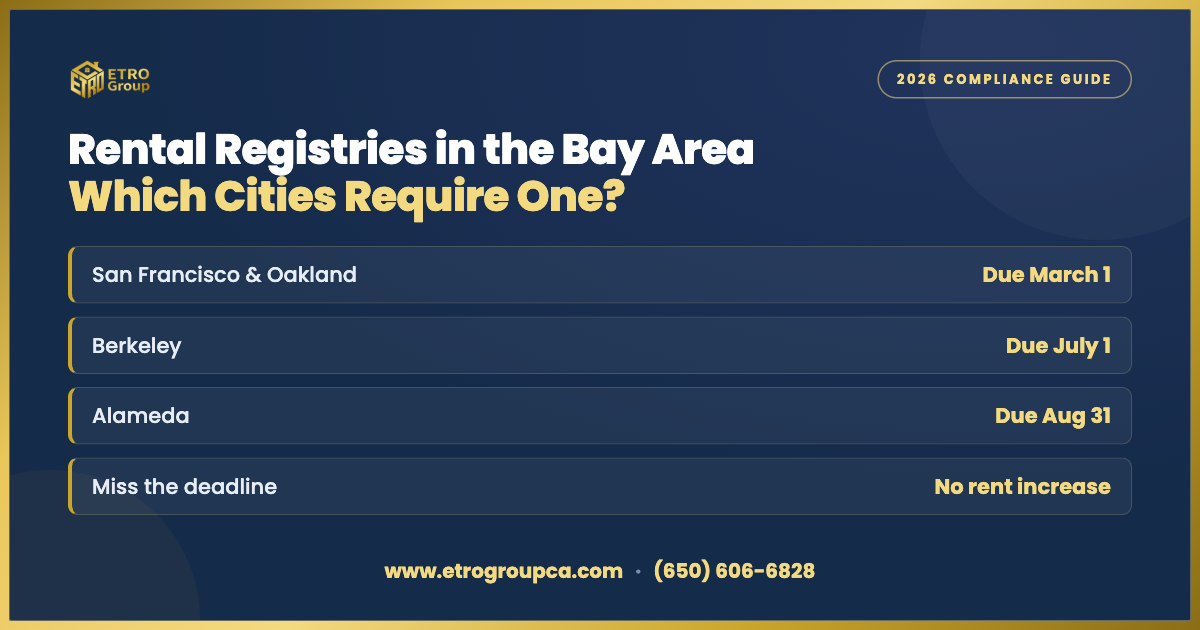
Rental registries in the Bay Area: which cities require one
September 14, 2026
Which Bay Area cities require rental registration — San Francisco, Oakland, San Jose, Berkeley, Alameda, Richmond & Concord — plus deadlines, fees, and non-compliance penalties.
Silicon Valley Rental Market Report 2026: Rents, Trends & Forecast
September 7, 2026
Silicon Valley's 2026 rental market: median rents by submarket, the AI and return-to-office demand surge, sub-5% vacancy, and a 6-7% rent-growth forecast.
Section 8 in Alameda County: The Landlord Compliance Guide
August 31, 2026
California's source-of-income law (SB 329) for Alameda County landlords — what income is protected, prohibited ad language, and correct income-to-rent math.
7 Signs It’s Time to Hire a Property Manager in the Bay Area
August 24, 2026
Seven clear signs you need a Bay Area property manager — from complex tenant laws and long vacancies to distance, tenant conflict, and a scaling portfolio.
August 16, 2026
California just-cause eviction in 2026 — AB 1482's 12-month trigger, at-fault vs no-fault grounds, Bay Area local ordinances, relocation fees, exemptions, and pitfalls to avoid.
Show More