Navigating the 2026 California Rental Law Landscape

January 15, 2026

Share this article

For property owners in the San Francisco Bay Area, 2026 marks a significant shift in the regulatory environment. As the CA Landlord and Tenant Law evolves, staying compliant is no longer just about good service—it is about legal survival. This guide outlines the critical changes every owner must understand regarding their Residential Lease agreements and daily operations.

New Statewide Mandates for 2026

The "baseline" for habitability has expanded significantly this year. Under AB 628, a dwelling is now legally considered uninhabitable unless it includes a functional stove and refrigerator. Should these appliances fail, owners are strictly mandated to repair or replace them within 30 days.

Furthermore, financial structures for new tenancies have changed under AB 12, which now limits all security deposits to a maximum of one month’s rent, regardless of whether the unit is furnished or unfurnished.

Regional Compliance: From Hayward to the Peninsula

Navigating local ordinances requires a hyper-local approach, as rules vary significantly by city:

  • Hayward: Properties built before 1979 fall under the RRSO, which currently caps annual rent increases at 5% and requires mandatory mediation for disputes.
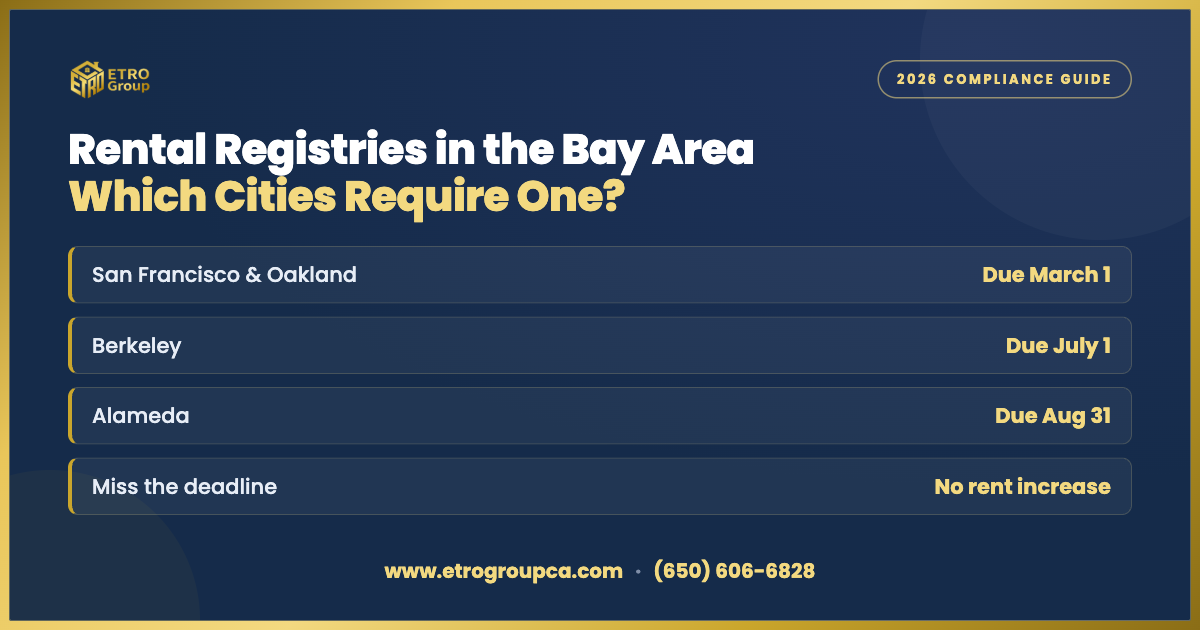
  • San Leandro: This area maintains a "ceiling" on increases at the lower of 3% or 65% of the CPI. Crucially, units must be registered by July 31; failure to register results in a complete freeze on rent increases.
  • San Francisco: For the 2026–2027 cycle, the allowable rent increase is set at a modest 1.6%, and owners must pay 4.2% interest on security deposits held.
  • Unincorporated Eden Area: In regions like San Lorenzo and Cherryland, "Fair Chance Housing" laws now strictly prohibit inquiring about or using an applicant’s criminal history during the screening process.

Transparency and the "Junk Fee" Ban

Under AB 1248, transparency is the new standard. Every potential cost—including parking, pet rent, and late fees—must be disclosed upfront in all advertisements and lease documents. Failure to disclose these can result in "triple-damage" penalties.

Additionally, for those owning single-family homes or condos, the AB 1482 exemption is not automatic. To maintain your right to market-rate increases, a specific legal notice must be physically present within the lease agreement.

Why Hire a Professional Property Manager?

While many owners consider self-management to reduce overhead, the complexities of 2026 legislation make a professional Property Management firm a vital asset.

  1. The Legal Shield: With the introduction of "Affirmative Defenses" for tenants on government benefits (AB 246) and strict "Just Cause" eviction requirements, a single procedural error can lead to months of lost income and costly litigation. A professional Property Manager acts as your first line of defense, ensuring every notice and lease term is legally sound.
  2. Mitigating the "Headache": From managing the new AB 2747 rent reporting requirements to coordinating high-resolution photo evidence for damage deductions (AB 2801), the administrative burden has never been higher.
  3. Digital Precision: Professional firms provide a digital audit trail. By digitizing vendor invoices and providing real-time portal access, they ensure that your investment is handled with the transparency and precision required by modern California law.

In this era of "The Registry Trap" and shifting appliance mandates, professional oversight is no longer a luxury—it is a strategic necessity for protecting your real estate assets.

Recent Posts

May 6, 2026
As we move into the spring selling season, the San Francisco Bay Area is once again witnessing a familiar trend: low inventory and high demand are creating a "hot" market environment. However, for a seller in 2026, market heat alone does not guarantee a successful or stress-free transaction. While buyers are eager, they are also navigating record-high entry costs, making them extremely sensitive to property condition, transparency, and legal compliance. If you are preparing to list your property, here is how to navigate the current environment with professional precision. 1. The "As-Is" Trap A common misconception in a competitive market is that a seller can list a property "as-is" and ignore minor defects. In 2026, however, the definition of a "habitable" home has reached a new standard that buyers—and their lenders—expect you to meet. Move-In Ready Premium: Properties that are turnkey and require no immediate repairs consistently see the highest number of offers and the shortest time on market. Transparency is Key: Providing a full "A to Z" disclosure packet upfront is the best way to prevent a deal from falling through during the inspection period. Digital Integrity: Buyers now start their journey online; high-resolution digital imaging is essential to create a "bulletproof" first impression and document the property’s true condition. 2. Navigating Local Disclosure Mandates Selling in the East Bay requires an understanding of a patchwork of local rules that can surprise an unprepared seller during escrow. Regional Nuances: Cities like Hayward and San Leandro have specific requirements regarding property transfers and local ordinances that must be handled correctly from day one. +1 No "Junk Fees": Under AB 1248 , every fee associated with the property or the transaction must be clearly disclosed upfront. Transparency is the only way to avoid potential triple-damage penalties after the sale. +1 Clear Documentation: Providing "before and after" photo evidence of any pre-sale repairs—similar to the digital imaging standards used in professional management—ensures a clear audit trail for the buyer. 3. Why Professional Strategy Beats Market Luck In a market defined by strict regulations and high buyer expectations, the "headache" of a botched disclosure can cost far more than any saved commission. The Legal Shield: A professional broker ensures that all mandatory notices and disclosures are present to protect your rights and your equity. Strategic Positioning: Success isn't achieved by starting with an "aspirational" price; it is achieved by creating a transparent, professional environment that gives buyers the confidence to make their best offer. Digital Audit Trails: Modern selling requires a digitized record of all vendor invoices and property improvements to ensure a seamless and legally sound transfer of ownership. The Bottom Line for 2026 Sellers In the current Bay Area climate, your greatest asset isn't just the property itself—it is the clarity and compliance you bring to the closing table. While the market’s velocity provides the momentum, a rigorous focus on professional presentation and upfront transparency is what ultimately protects your equity. By treating your sale as a high-stakes professional transition rather than a simple transaction, you bypass the common "headaches" of 2026 and ensure that your move to the next chapter is as profitable as it is secure.
April 6, 2026
For many investors in the San Francisco Bay Area, the path to financial independence often feels like a choice between the high-growth potential of the tech-heavy stock market and the tangible, high-value world of local real estate. However, the most resilient portfolios in 2026 are rarely "all-in" on a single asset. Instead, they rely on a balanced strategy that plays to the strengths of different markets. Below is a breakdown of how to weigh these options as you build your investment foundation.  1. The Bay Area Real Estate Advantage Real estate remains a cornerstone of wealth in the East Bay for several key reasons that "paper assets" simply cannot match. The Power of Leverage: Unlike stocks, where you typically pay the full price of the asset, real estate allows you to control a high-value property with a fraction of the cost down. Tax Efficiency: Through depreciation and mortgage interest deductions, real estate offers a "tax shield" that helps you keep more of what you earn. Tangible Security: While a stock price can fluctuate wildly overnight, a Residential Lease property in a high-demand area like Hayward or San Leandro provides a steady stream of rental income and long-term appreciation. 2. Stocks and the Tech Sector Being in the heart of Silicon Valley, many of us are naturally drawn to the stock market. Liquidity: Stocks offer the ability to move in and out of positions quickly, which is something real estate cannot do. Diversification: While real estate ties you to a specific zip code, a well-balanced stock portfolio allows you to own a piece of the global economy. Strategic Growth: Focusing on broad indices or diversified tech holdings can provide the growth needed to fund your next property down payment. 3. The Role of Gold (and Alternatives) Gold has traditionally served as the "ultimate insurance policy." In a diversified 2026 portfolio, it acts as a stabilizer. Inflation Hedge: When the cost of living rises, gold historically maintains its purchasing power. Risk Mitigation: Gold often moves in the opposite direction of the stock market, providing a safety net during periods of high volatility. The 50-30-10-10 Strategy To balance growth, stability, and high-value assets, a structured allocation can provide a clear roadmap: 50% Stocks: For growth and liquidity. 30% Real Estate: For leverage, tax advantages, and rental income. 10% Gold: For wealth preservation. 10% Alternative Assets: For high-upside potential in a digital economy. Why Professional Guidance Matters Managing a multi-asset portfolio—especially one involving physical property—requires more than just a search bar. Regulatory Compliance: Managing property in California means navigating a complex web of statewide and local mandates. From the new appliance requirements under AB 628 to the "Junk Fee" bans of AB 1248 , one legal oversight can erase your investment gains. +1 Market Insight: A professional Property Manager or broker doesn't just manage buildings; they manage your ROI. By ensuring your property is compliant with the "A to Z" of local disclosures , they protect your asset from triple-damage penalties and the "Registry Trap" found in cities like San Leandro. +2 Efficiency: Professional management ensures your real estate investment remains a "passive" income stream, not a second full-time job, by handling the high-resolution documentation and digitized audit trails required for protection today. Final Takeaway for 2026 Investors In the end, successful investing in the Bay Area isn’t about finding a single "winner"—it’s about building an ecosystem where your assets complement one another. While stocks provide the growth to expand your reach, and gold provides the safety net for your peace of mind, real estate provides the foundational stability that turns a portfolio into a legacy. By combining a diversified plan with the right professional expertise, you can navigate market volatility with confidence, ensuring your wealth continues to grow as the Bay Area evolves.
February 18, 2026
The most common complaint from aspiring buyers in the Bay Area is a simple one: "It’s just too expensive." While the entry price in the East Bay is undeniably high, it is important to view a home purchase not just as a cost, but as a pivot from paying someone else’s mortgage to building your own equity. If you are tired of the annual rent hike cycle and the uncertainty of the rental market, here is how to navigate your first purchase in today’s East Bay landscape. 1. Why the East Bay is the "Smart" Move While San Francisco and the Peninsula often grab the headlines, the East Bay—cities like Hayward, San Leandro, and Oakland —offers a unique blend of value, space, and lifestyle that is increasingly hard to find elsewhere. The "Commuter’s Edge": You can often find a home with more square footage and a private yard for the price of a cramped studio or small condo across the bridge. With the robust BART network and major highway corridors, you remain connected to the region's core job hubs while enjoying a more suburban feel. Neighborhood Variety: The East Bay is not a monolith; it is a collection of diverse "pockets." From the hillside views and newer developments in Hayward to the historic charm and tree-lined streets of San Leandro , there is a neighborhood for every budget and aesthetic if you know where to look. Long-Term Appreciation: Historically, the East Bay has shown resilient property value growth. Buying here isn't just about finding a place to sleep; it’s about capturing the upward trajectory of one of the world's most enduring economies. 2. Overcoming the Affordability Barrier You don't need a massive inheritance or a multi-six-figure windfall to buy a home in 2026. There are sophisticated financial tools designed specifically to help first-time buyers get over the finish line. Low Down Payment Options: Many buyers are surprised to learn that the "20% down" rule is a myth. You can often qualify for conventional or FHA loans with as little as 3% to 5% down , allowing you to enter the market much sooner than you thought. State & Local Assistance: Programs like CalHFA offer deferred-payment junior loans to help cover down payments or closing costs. These are game-changers for buyers who have the income to support a mortgage but lack the upfront cash. Fixed Housing Costs: This is the ultimate hedge against inflation. Unlike a Residential Lease , where your rent can increase annually based on CA Landlord and Tenant Law caps, a fixed-rate mortgage stays the same for the life of the loan. You are essentially "locking in" your housing cost for the next 30 years while your income (and the home's value) likely grows. 3. Removing the "Headache" of the Hunt The biggest reason buyers hesitate is the fear of making a costly mistake. In a market this competitive, "winging it" is not an option. This is where professional expertise transforms a stressful ordeal into a streamlined success. The "A to Z" of Disclosures: A home is a complex machine with many moving parts. A professional broker helps you "read between the lines" of thick disclosure packages and inspection reports, ensuring you understand the true condition of the property before you sign. Hyper-Local Strategy: Real estate is local. Every city in the East Bay has different transfer taxes, point-of-sale ordinances (like sewer lateral or seismic requirements), and local mandates. Having a guide ensures there are no expensive surprises at the closing table. Negotiation Power: In a market where multiple offers are the norm, price is only one factor. An expert knows how to structure your offer—balancing contingencies, timelines, and even your personal "story"—to make your bid stand out to a seller. Closing Thoughts Buying your first home is a milestone that changes your financial trajectory forever. It’s natural to feel overwhelmed by Bay Area prices, but when you stop looking at the "sticker price" as a hurdle and start looking at it as an entry into long-term stability, the East Bay becomes a land of opportunity. You aren't just buying a house; you are reclaiming control over your future. You are finally coming home.