
The Future of Property Management: Why AI Is a Partner, Not a Replacement

July 13, 2026

By: Jian Hui Zhu, Real Estate Broker (DRE #02129313)

Published by ETRO Group Inc. (DRE #02441215)

Share this article

In an era where AI tools like Gemini, ChatGPT, and Grok can summarize complex legal statutes and draft compliance-focused correspondence in seconds, many property owners are asking a provocative question: Do I still need a professional property manager?


The short answer is no, AI will not replace property managers. However, the role of the property manager is undergoing a permanent transformation. The value proposition is shifting away from "administrative processing" and toward "strategic advisory and relationship management."


To understand why this profession is evolving rather than disappearing, we must distinguish between what AI does (data processing) and what property management is (human stewardship).


The Limits of Automation

While AI excels at pattern recognition and information retrieval, property management remains fundamentally a relationship-based business. Here is why the human element is irreplaceable:

  • Liability and Accountability: AI can draft a lease clause, but it cannot exercise the judgment required to navigate complex, hyper-local Fair Housing laws. If an automated system makes a discriminatory error, the legal and financial liability falls solely on the property owner. A professional property manager acts as the necessary human filter, ensuring compliance while mitigating risk.
  • The Nuance of Crisis: AI is excellent at routine communication, but it fails when the "routine" breaks down. Whether it is de-escalating a high-stakes conflict between tenants or negotiating with a vendor during a property emergency at 2:00 AM, the human capacity for empathy, intuition, and complex problem-solving remains unmatched.
  • Strategic Judgment: AI operates on historical data. A professional manager provides forward-looking strategy—advising owners on when to pivot their business model, how to approach high-level asset improvements, and how to navigate edge cases that defy standard templates.


Traditional Task vs. The AI-Augmented Approach

Rather than replacing the manager, AI is eliminating the "administrative friction" that has historically bogged down the industry. Professionals who embrace these tools are not becoming obsolete; they are becoming more productive and more valuable.

Traditional Task The AI-Augmented Approach
Routine Inquiries Instant, 24/7 AI-driven responses
Administrative Burden Automated rent collection, renewals, and dispatching
Market Data Instant analysis of financial reports and trends
Service Quality AI-enabled playbooks for consistent standards

The New Value Proposition

As AI handles the "administrative chaos," property managers are gaining back the time to focus on high-value, human-centric activities that directly impact an owner's bottom line:

  • Strategic Asset Growth: Shifting focus from "taking rent" to "increasing property value" through long-term portfolio advisory.
  • Sophisticated Negotiation: Managing vendor contracts and complex lease disputes where human intuition is required to secure the best outcome.
  • High-Trust Relationships: Building the tenant loyalty and owner trust that ultimately drive long-term retention and stability.

The Bottom Line

The landscape of real estate management is changing. The future does not belong to those who resist technology, nor does it belong to the software itself. The future belongs to the property manager who leverages AI to handle the manual tasks, thereby freeing themselves to deliver the strategic, human-led service that keeps investments safe, compliant, and profitable.

As a property owner, your focus should not be on choosing between AI and a manager—it should be on finding a partner who uses the best of both worlds.

Managing with modern efficiency and human expertise?

Let's discuss how ETRO Group can elevate your investment strategy across the Bay Area. We manage rentals across Hayward, San Leandro, Fremont and 13 more Bay Area cities.

⚡ KEY TAKEAWAYS

  • AI won't replace property managers — it's shifting the role from admin processing to strategy and relationships.
  • Human judgment stays essential for compliance & liability, crisis handling, and forward-looking strategy.
  • AI removes administrative friction (inquiries, rent collection, market data), freeing managers for high-value work.
  • The smart move for owners: a partner who pairs AI efficiency with human expertise.


Recent Posts

Tri-Valley Rent Control 2026: Dublin, Pleasanton, Livermore & San Ramon
October 18, 2026
None of the four Tri-Valley cities has citywide rent control for market-rate rentals. AB 1482 still caps covered units at 8.8% through July 31, 2027.

The Complete Move-Out & Turnover Checklist for California Landlords
October 11, 2026
California landlords have 21 days to return a deposit. The move-out and turnover checklist: inspections, wear vs. damage, deposit caps, make-ready work.
How to Reduce Tenant Turnover & Vacancy in the Bay Area (2026)
October 4, 2026
One tenant turnover costs a Bay Area landlord $6,750–$9,900+. The 2026 playbook to reduce turnover and vacancy: retention, AB 1482 limits, renewal timing.

A 1031 Exchange Guide for Bay Area Real Estate Investors
September 27, 2026
How a 1031 exchange defers capital gains for Bay Area investors — the like-kind rules, buying multiple properties, the 45/180-day deadlines, and the “swap till you drop” step-up strategy.

Bay Area rental property storm preparation checklist
September 24, 2026
A Bay Area landlord's storm-season checklist: gutters and drainage, tree and wind hazards, HVAC service, weatherstripping, smoke and CO alarms, plus the habitability duties California law puts on owners during severe weather.

East Bay vs. Peninsula: Where Should You Buy a Rental Property?
September 21, 2026
A deep-dive investment analysis comparing the East Bay and the SF Peninsula across entry price, cap rates, tenant profiles, rent control, and market velocity.
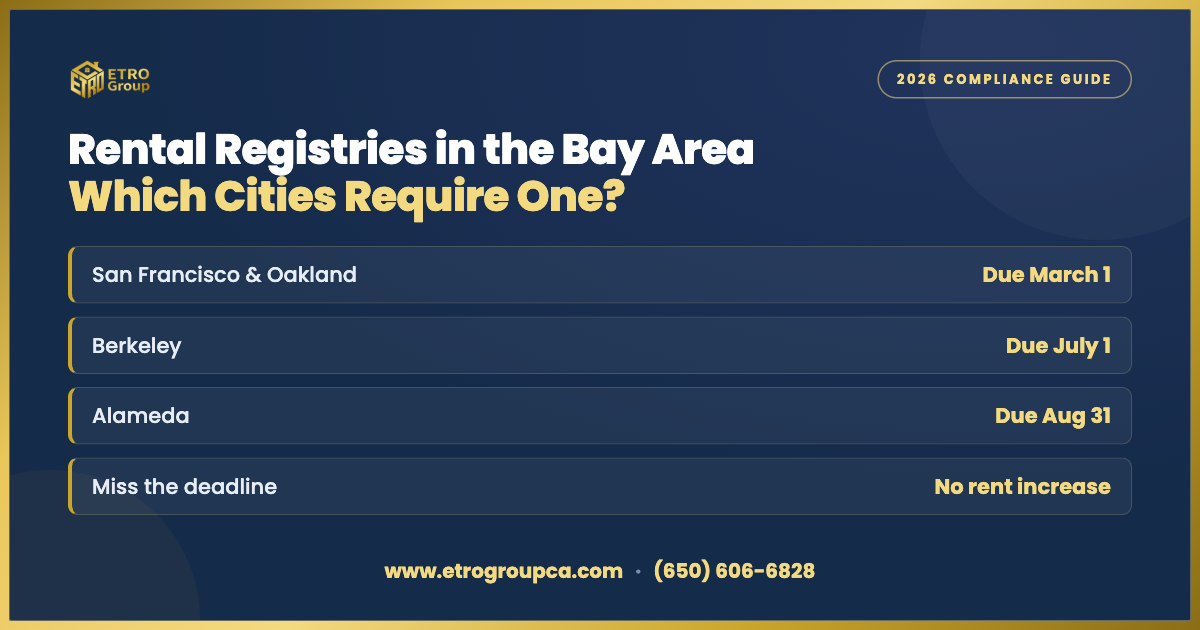
Rental registries in the Bay Area: which cities require one
September 14, 2026
Which Bay Area cities require rental registration — San Francisco, Oakland, San Jose, Berkeley, Alameda, Richmond & Concord — plus deadlines, fees, and non-compliance penalties.
Silicon Valley Rental Market Report 2026: Rents, Trends & Forecast
September 7, 2026
Silicon Valley's 2026 rental market: median rents by submarket, the AI and return-to-office demand surge, sub-5% vacancy, and a 6-7% rent-growth forecast.

Section 8 in Alameda County: The Landlord Compliance Guide
August 31, 2026
California's source-of-income law (SB 329) for Alameda County landlords — what income is protected, prohibited ad language, and correct income-to-rent math.
7 Signs It’s Time to Hire a Property Manager in the Bay Area
August 24, 2026
Seven clear signs you need a Bay Area property manager — from complex tenant laws and long vacancies to distance, tenant conflict, and a scaling portfolio.
Show More